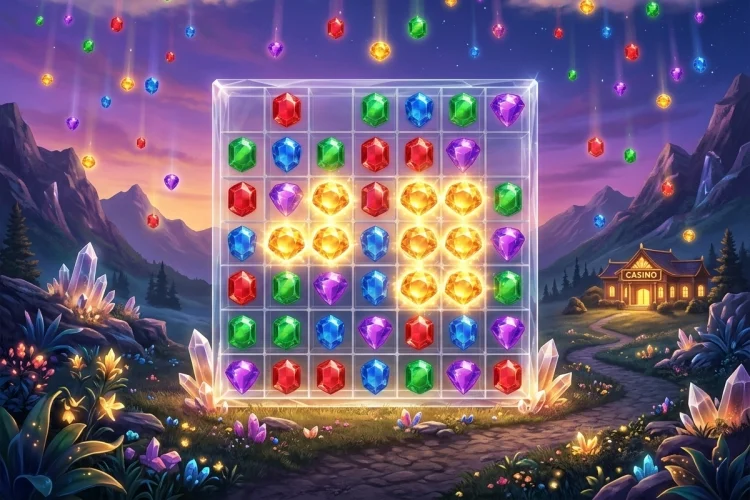
Traditional slot games ask you to follow symbols across fixed paylines. Cluster games take a more visual approach: matching icons simply need to touch one another in a large enough group.
That makes Cluster Pays Slots look easy, but beginners may still wonder which symbols count, whether diagonal connections qualify, and why the grid keeps refilling after a win.
The answers depend on the individual game, although many titles follow a similar structure. Once you understand clusters, cascades, wilds, and multipliers, these grid-based games become much easier to follow.
The mechanic does not guarantee more wins than ordinary slots, but it creates a faster and more interactive style of play.
What Is a Cluster Win?
A cluster is a connected group of identical symbols. In many games, at least five matching icons must touch horizontally or vertically to create a payout.
Diagonal symbols usually do not count unless the game rules specifically allow them. Reactoonz, for example, forms wins when five or more matching alien symbols connect on its 7×7 grid.
Larger groups generally pay more than smaller ones. The exact prize depends on the symbol type, cluster size, and stake.
How Symbols Connect on the Grid
Imagine five apple symbols arranged in an L shape. Three touch horizontally, while two extend downward from the final apple.
Because every symbol connects through a horizontal or vertical edge, the entire group can count as one cluster. If another apple appears nearby but touches only at the corner, it will normally remain outside the group.
This makes cluster games feel more like puzzle boards than traditional reel machines.
What Happens After a Win?
Many cluster games also use cascading or tumbling symbols. Once a group pays, the winning icons disappear and new symbols fall into the empty spaces.
The refreshed board is then checked again. If another qualifying group forms, the game awards an additional win without charging for a separate spin.
Reactoonz follows this pattern by removing winning aliens and replacing them from above. The reaction continues until no new cluster appears.
Wilds and Multipliers Add Variety
Wild symbols usually substitute for standard paying icons, helping complete or enlarge a group. Some wilds also carry multipliers that increase after contributing to a win.
Jammin’ Jars 2 uses multiplier wild jars beside paying clusters. When a jar participates, its value is added to the cluster prize, while other features can create large groups of matching fruit.
Different games handle wilds differently. Some remain in place, some move, and others disappear during the cascade, so reading the paytable is essential.
Cluster Games Can Include Grid Progression
Certain titles connect cluster wins to visible progress. Instead of merely paying and disappearing, successful groups may clear tiles, charge meters, or unlock bonus features.
Cluster Tumble uses an 8×8 grid containing blocks that must be destroyed through winning reactions. Wilds and power-up blocks can help clear the path toward its temple feature.
This gives players something easy to follow, although a nearly completed grid does not guarantee the final required result.
Are Bigger Clusters Always Better?
A larger group normally pays more than a minimum-sized one, but symbol value still matters. A large cluster of low-paying icons may be worth less than a smaller group of premium symbols.
Fruit Party uses a 7×7 grid and can attach random multipliers to symbols involved in winning groups. Multiple values may combine up to a stated maximum of 256x.
The number of symbols is therefore only one part of the calculation. Multipliers, wilds, and the game’s paytable can all affect the final prize.
What Beginners Should Check
Before playing, find the minimum cluster size and confirm whether diagonal symbols qualify. Then check how wilds behave, whether wins cascade, and when multiplier progress resets.
RTP should also be viewed realistically. It is a long-term theoretical average, and previous results do not change the probability of a future random outcome.
Demo mode is useful for learning these rules without financial pressure. Keep the virtual stake consistent and focus on how groups form rather than judging the game from one lucky sequence.
Cluster Pays Slots replace fixed paylines with connected groups of matching symbols. Most require five or more icons touching horizontally or vertically, although the exact rules vary.
Winning groups may disappear, allowing cascades, wild interactions, multipliers, and grid-clearing features to continue the same round.
Start by reading the paytable and identifying the minimum group size, cascade rules, and special symbols. Explore a legal demo to practise spotting clusters before considering cash play.
Treat every result as random, use only an affordable entertainment budget, and choose a game because its mechanics are clear and enjoyable-not because a large cluster appears overdue.