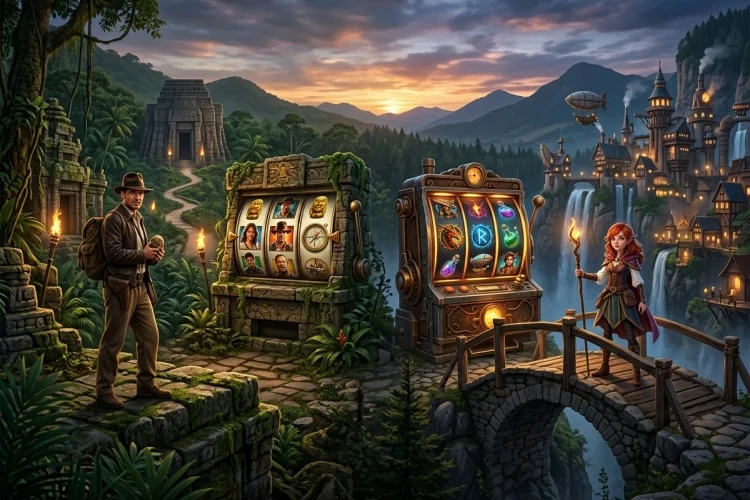
A familiar movie logo can make an online slot instantly noticeable. Before you even understand the paylines, you may already recognise the characters, soundtrack, locations, or story behind the game.
Original titles take the opposite approach by introducing a world created specifically for the reels. The comparison between Branded Slots vs Original Slot Games is not simply about famous names versus unfamiliar artwork.
Both categories can offer detailed bonuses, strong graphics, memorable music, and unusual mechanics. The real difference is where the theme comes from.
Branded games use licensed intellectual property, while original releases rely on concepts, characters, and visual identities developed by the game studio.
What Is a Branded Slot?
A branded slot is based on an existing entertainment property, public figure, television programme, film, music artist, or recognised commercial franchise. The developer receives permission to use protected names, images, characters, and other creative material.
Jumanji is a clear example. NetEnt’s game is based on the 1995 movie and uses a board-game bonus, thematic free-spin modes, animals, and visual elements connected to the film.
Pragmatic Play’s Peaky Blinders project was similarly created through a licensing partnership involving the owners and representatives of the television property.
What Is an Original Slot Game?
An original game uses a concept created primarily by the provider rather than borrowed from an external entertainment franchise. The studio develops its own characters, symbols, soundtrack, story, and overall visual style.
Starburst is an example of an original NetEnt release. It uses a space-and-gem theme, five reels, ten paylines, and expanding wild respins without depending on a movie or celebrity licence.
An original concept can later become a recognisable slot franchise. Reactoonz began with studio-created alien characters and has since expanded into sequels and related releases.
Familiarity Versus Discovery
The main advantage of a branded title is immediate familiarity. Fans may enjoy seeing recognisable characters, hearing familiar music, and discovering how scenes from the original property have been converted into bonus features.
Original releases offer more discovery. You enter without knowing the characters or world, which allows the provider to build the experience entirely around the slot mechanics.
Neither approach is automatically more engaging. A famous logo may attract attention, but the gameplay still needs to remain interesting after the initial recognition wears off.
How Themes Influence Bonus Features
The strongest branded games connect their bonuses to the source material. Jumanji does this with a bonus board, dice rolls, animal-based modifiers, and four thematic free-spin modes.
Music-based games can use licensed tracks as part of the presentation. NetEnt’s Jimi Hendrix title combines psychedelic visuals and music connected to the artist.
Original titles have greater freedom to create features without matching an existing storyline. Reactoonz uses clusters, cascading aliens, energy meters, wild transformations, and the Gargantoon character as parts of one studio-created system.
Does Branding Affect RTP?
A licensed name does not reveal whether a slot has a high or low theoretical return. Jumanji is officially listed with 96.33% RTP, while the original Starburst is listed at 96.09%.
These examples do not prove that branded games generally pay more. They show that every title must be checked individually.
Regulated games should make information about rules, payouts, and RTP or winning probabilities available before a customer commits to play.
Compare Volatility Separately
Volatility describes how prizes are distributed. A highly volatile game may concentrate more of its value in large but rare outcomes, while a lower-volatility title generally produces smaller and more frequent prizes.
This mathematical profile is independent of whether the artwork comes from a film or an original concept. The UK Gambling Commission explains that volatility and theoretical RTP are separate characteristics of a game.
Always check both figures instead of judging risk from the theme.
How to Compare the Two Categories
Start by ignoring the logo and reading the paytable. Compare the winning system, wilds, free spins, multipliers, maximum prize, RTP, and volatility.
Next, consider whether the theme adds something meaningful. A licensed soundtrack or board-game feature can improve immersion, while an original title may provide more unusual symbols and mechanics.
Use demo mode where legally available. The better game is the one whose rules remain clear and entertaining after the first few spins.
The key difference in Branded Slots vs Original Slot Games is the source of the theme. Branded titles use licensed films, television series, musicians, or other recognised properties.
Original releases introduce characters and worlds designed by the provider. Familiar branding can create instant appeal, while original games often provide greater creative freedom and the chance to discover a new slot universe.
Neither category automatically offers better RTP, lower volatility, or stronger bonuses. Compare the exact mathematical details and feature rules inside each game.
Try an official demo, focus on gameplay rather than celebrity recognition, and keep real-money sessions within firm entertainment limits.